


 English
 русский
 Español
Industry News
Charger For Power Tools Output Voltage Must Match Cell Count
A battery pack for a cordless tool carries a voltage on its label, and the charger has to fit that number closely. Too little and the pack does not reach full charge. Too much and the cells are pushed past their limit. A Charger For Power Tools looks like a plain box with a plug, yet its output voltage is the specification that decides whether it suits a given pack at all.
Output Voltage Follows the Series Cell Count
A lithium-ion cell is charged to about 4.2 volts. Cells wired in series add up: three cells reach 12.6 volts, four reach 16.8 volts, and five reach 21 volts. Those three figures match the output voltages listed on the supplier's page for its 12.6V, 16.8V, and 21V models, which is how many tool chargers are sorted. Pack labels often show a lower nominal voltage, so a buyer matching a Charger For Power Tools to a pack should compare the full-charge voltage, not just the number printed on the pack sticker.
Why Overshoot Matters
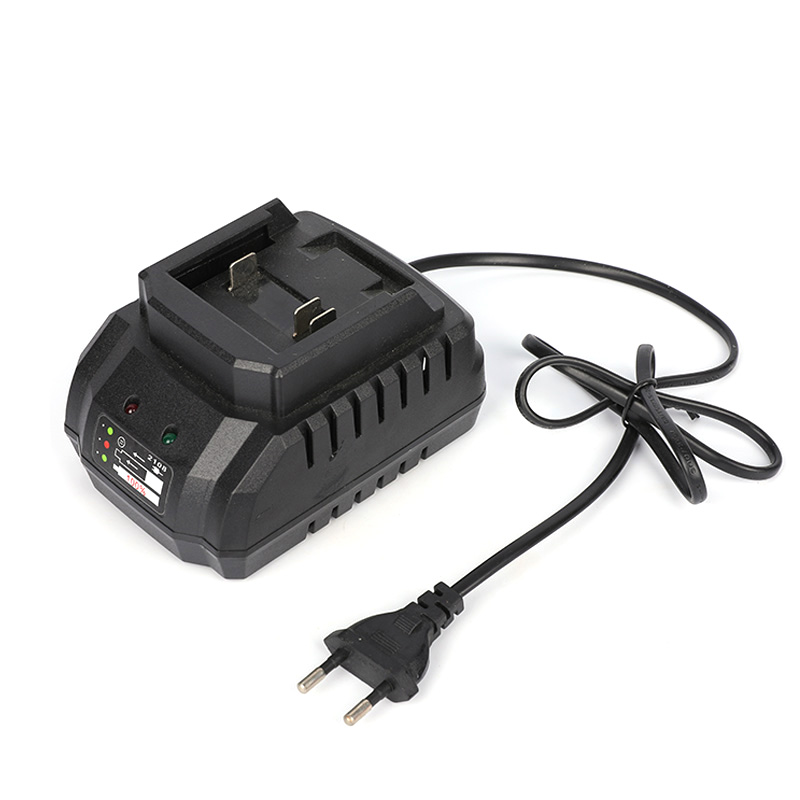
Lithium packs usually contain a protection circuit, but a Charger For Power Tools that delivers more than the pack was built for places stress on that circuit and on the cells. Heat builds, and cell life can shorten. A charger that delivers less simply leaves some capacity unused, which users tend to notice as shorter run time. Distributors who label voltage clearly on the box and on the charger body reduce the chance that a customer picks the wrong one.
Input Range and Plug Type
The supplier lists the input as 100 to 240 volts at 50 to 60 hertz, which covers the mains supply in many countries. That range lets the same charger body serve several markets, with the plug being the main difference. The listed models use an Australia and New Zealand style socket, so a buyer selling elsewhere would confirm which plug type can be fitted before ordering. An importer handling several countries may want to specify plug type per market in the purchase order.
Connector and Contact Layout
Tool packs from different brands use different terminals, and a charger has to meet the pack both physically and electrically. Even when voltage matches, a poor contact fit can cause intermittent charging, heat at the terminals, or no charge at all. Polarity matters too, since reversed contacts can damage a pack. A buyer sourcing a Charger For Power Tools to match a particular pack would check connector shape, contact position, and polarity against the original charger.
Charging Speed and Heat
The listed models are described as quick chargers. Faster charging raises more heat in the charger and the pack, so charge time, temperature handling, and the indicator lights that show charging status are all worth asking about. The page gives no charge times or current ratings, so buyers who care about speed request those figures in writing. A Charger For Power Tools that charges quickly but runs hot may please a user in the workshop and frustrate one who worries about pack life.
Matching a Charger to Many Pack Types
The supplier states that its products match many domestic and international tool brands, and a Charger For Power Tools range follows the same logic: a small number of voltage classes spread across many connector styles. Distributors often keep a short table linking pack voltage, connector type, and charger model so that counter staff can answer questions quickly. A clear cross-reference tends to cut returns more than any other single step.
What Buyers Typically Compare
For distributors and tool-accessory importers sourcing this category, useful comparison points include output voltage against the pack's full-charge voltage, input range, plug type, connector layout, charge time at a stated current, and how the charger is packed for shipping. Yongkang Creator Import & Export Co., Ltd., based in the Economic Development Zone of Yongkang City, Zhejiang, lists 12.6V, 16.8V, and 21V lithium-ion chargers with a 100 to 240 volt input in its lithium electric tools spare parts range, alongside battery adapters and rechargeable batteries. Buyers can request samples of each Charger For Power Tools, charge the intended packs, and check voltage, temperature, and charge time before placing a larger order.
Copyright © Yongkang Creator Import & Export Co.,Ltd. All Rights Reserved.

Power Tools and Other Universal Spare Parts Manufacturer