


 English
 русский
 Español
Industry News
Armature For Power Tools Depends on Motor Balance?
An Armature For Power Tools operates inside a motor at high rotational speed, converting electrical input into mechanical movement that eventually reaches the tool's working mechanism. While users usually notice the drill, grinder, or cutter on the outside, the rotating assembly inside has to maintain its mechanical and electrical characteristics throughout repeated operation. This makes armature construction, winding, shaft alignment, commutator condition, and dynamic balance important considerations when replacement components are developed.
The Armature Is Part of a Larger Motor System
An Armature For Power Tools does not work independently. In a brushed motor, electrical current reaches the rotating assembly through the carbon brushes and commutator, while the stator provides the magnetic field required for rotation. The resulting movement is transferred through the motor shaft and, depending on the tool, may then pass through gears or other transmission components.
This relationship means that replacing an armature requires more than checking whether the part can physically enter the motor housing. Shaft dimensions, commutator position, winding configuration, bearing locations, and compatibility with the stator can all influence whether the replacement operates correctly.
Winding Construction Affects Motor Operation
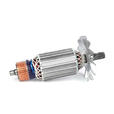
Copper windings are one of the most important elements of the rotating assembly. When current passes through the windings, electromagnetic forces contribute to the rotational movement of the armature.
For an Armature For Power Tools, winding arrangement needs to correspond with the intended motor design. Different power tools can have different voltage, speed, torque, and dimensional requirements, so armatures that appear similar externally may not necessarily be interchangeable.
The insulation surrounding the winding is also relevant because the motor can generate considerable heat during continuous operation. Material selection and winding construction therefore need to be considered alongside the expected operating conditions.
Dynamic Balance Becomes Important at High Speed
An armature rotates rapidly, which makes balance a significant mechanical consideration. If mass is distributed unevenly around the rotating assembly, centrifugal forces can produce vibration during operation.
For an Armature For Power Tools, balancing can involve correcting small differences in the rotating assembly so that it runs more smoothly. Excessive vibration can affect not only the armature but also bearings, housings, gears, and other connected components.
This is one reason the manufacturing process cannot focus only on electrical characteristics. Mechanical precision also matters when a component is expected to rotate repeatedly at high speed.
The Shaft Connects the Motor to the Tool
The armature shaft transfers rotational force from the motor to the next stage of the power tool. Depending on the tool design, the shaft may connect directly to a gear assembly or another transmission mechanism.
A replacement Armature For Power Tools therefore needs accurate shaft dimensions and appropriate positioning. The diameter, length, bearing seats, gear connection, and other details can determine whether the component integrates correctly with the existing motor structure.
A small dimensional difference can become significant once the armature is installed because the shaft has to maintain its relationship with several surrounding components simultaneously.
Commutator and Carbon Brush Interaction
In brushed motors, the commutator provides the electrical contact surface for the carbon brushes. As the armature rotates, the brushes remain in contact with the commutator while electrical current is transferred into the rotating winding system.
This means the surface condition of the commutator can influence the working relationship between the Armature For Power Tools and carbon brushes. Uneven wear, excessive sparking, or contamination may indicate that the motor requires inspection rather than simply replacing whichever component is easiest to access.
The supplier's spare-parts information specifically identifies carbon brushes as components that conduct electricity from the commutator to the armature, illustrating the close relationship between these two parts.
Replacement Requires More Than Visual Matching
For distributors and repair businesses, armature sourcing often begins with the tool model, but additional specifications may be needed. Shaft dimensions, armature length, commutator size, winding characteristics, bearing position, and compatibility with the corresponding stator can all help identify the appropriate replacement.
This is particularly relevant when maintaining different brands or generations of power tools. A visually similar Armature For Power Tools may still have different electrical or mechanical characteristics.
The supplier's product range covers spare parts for different power tools and identifies rotors as a key motor component, with the rotor described as precision-balanced and designed to work with corresponding stators.
Manufacturing Accuracy Shapes Replacement Performance
The armature may be hidden inside a power tool, but its manufacturing requirements are closely connected with how the finished tool behaves. Winding accuracy, shaft machining, commutator assembly, insulation, and dynamic balancing all contribute to the final rotating assembly.
For B2B buyers, an Armature For Power Tools should therefore be evaluated as a precision motor component rather than simply a replaceable metal part. Compatibility with the stator, bearings, carbon brushes, and transmission system needs to be considered together.
As power tools continue to operate at high rotational speeds and under varying loads, the development of replacement armatures increasingly depends on coordination between electrical design and mechanical manufacturing. A well-matched rotating assembly can then perform its intended role within the larger motor system without treating the armature as an isolated component.
Copyright © Yongkang Creator Import & Export Co.,Ltd. All Rights Reserved.

Power Tools and Other Universal Spare Parts Manufacturer